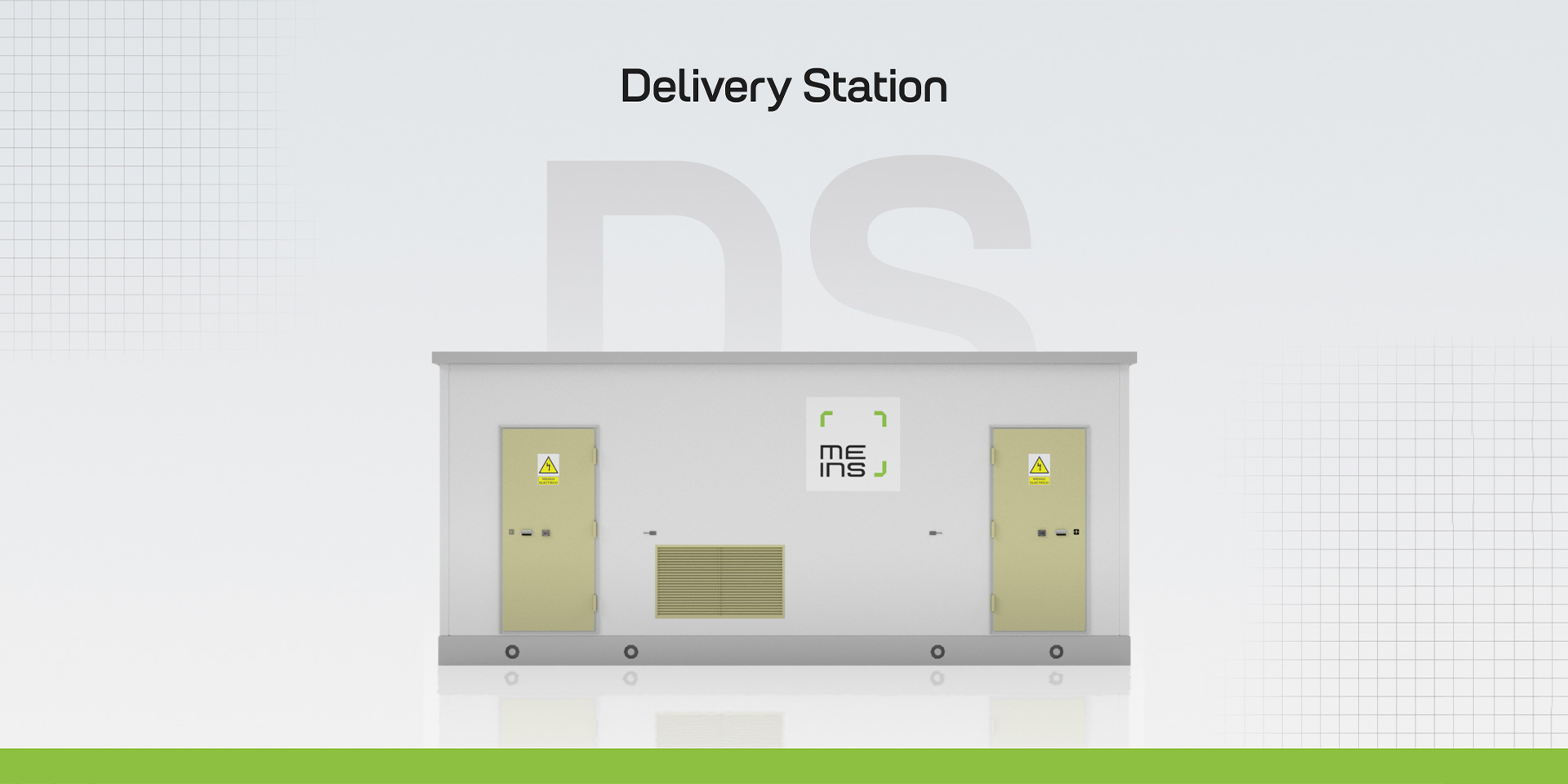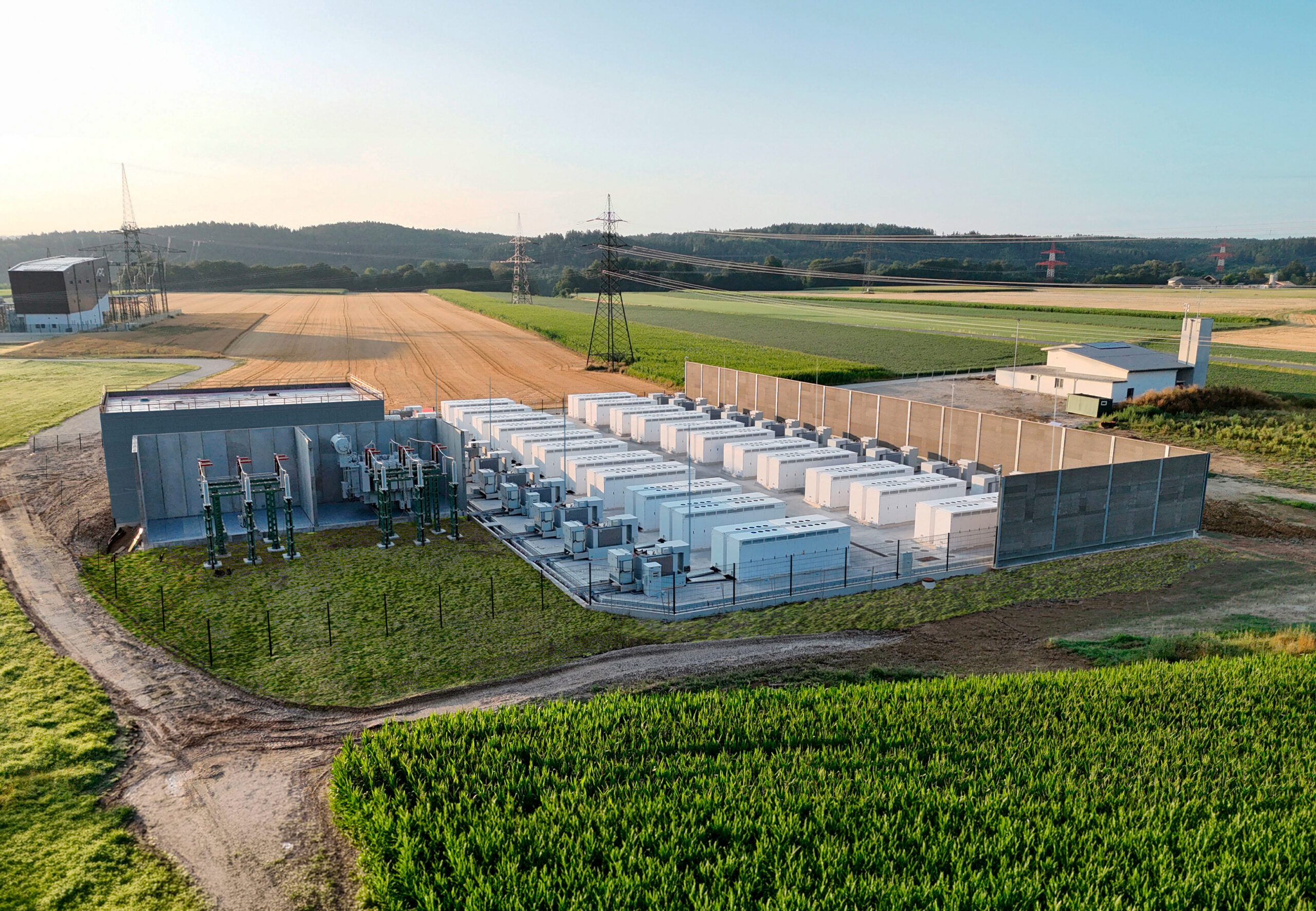
MEINS Battery Power Stations (BPS) are prefabricated transformer stations specifically designed for the electrical integration of utility-scale BESS systems. Three configurations are available: BPS-S for battery containers with integrated multi-PCS architecture (up to 9.6 MVA), BPS-C for systems with external centralized PCS (up to 8.8 MVA), and BPS-D for battery containers with integrated centralized PCS (up to 7.2 MVA). The choice between them depends principally on the PCS architecture of the battery system.
Why choosing the right BPS is a critical decision in BESS projects
In a utility-scale BESS system, the electrical integration infrastructure is not a secondary component. It is the element that determines compatibility with the selected battery system, energy conversion efficiency, asset scalability and, ultimately, its bankability.
The Battery Power Station (BPS) is MEINS’ solution for this integration. It combines the power transformer, medium-voltage switchgear, low-voltage panel and all auxiliary components in a prefabricated concrete platform, following a Plug & Play philosophy and ready for direct connection to the battery container.
However, there is no universal BPS. The architecture of the Power Conversion System (PCS) of the battery system — multi-PCS integrated into the battery container, external centralized PCS, or integrated centralized PCS — determines which BPS configuration is the right one for each project. Choosing the wrong one has a direct impact on CAPEX, timelines, and system reliability.
This technical guide explains in detail the three available configurations, their technical specifications, their compatibility with the main battery manufacturers on the market, and the selection criteria for each project scenario.
What is a Battery Power Station (BPS) and what does it include?
A MEINS BPS is a prefabricated transformer station made of vibrated and reinforced concrete, specifically designed for the electrical integration of battery energy storage systems. Unlike a conventional transformer station, the BPS is designed to connect directly — physically and electrically — to the battery container, forming an integrated system that is ready for connection to the medium-voltage grid.
All MEINS BPS models include as standard:
- Power transformer with biodegradable oil
- Integrated transformer oil retention tank
- Medium-voltage (MV) switchgear up to 40.5 kV
- LV panel for PCS and auxiliary services protection
- Auxiliary services transformer
- Prefabricated concrete platform
- Perimeter fencing
- Fire detection and anti-intrusion system
- MV, LV, and earthing system cabling
- European manufacturing with declaration of origin
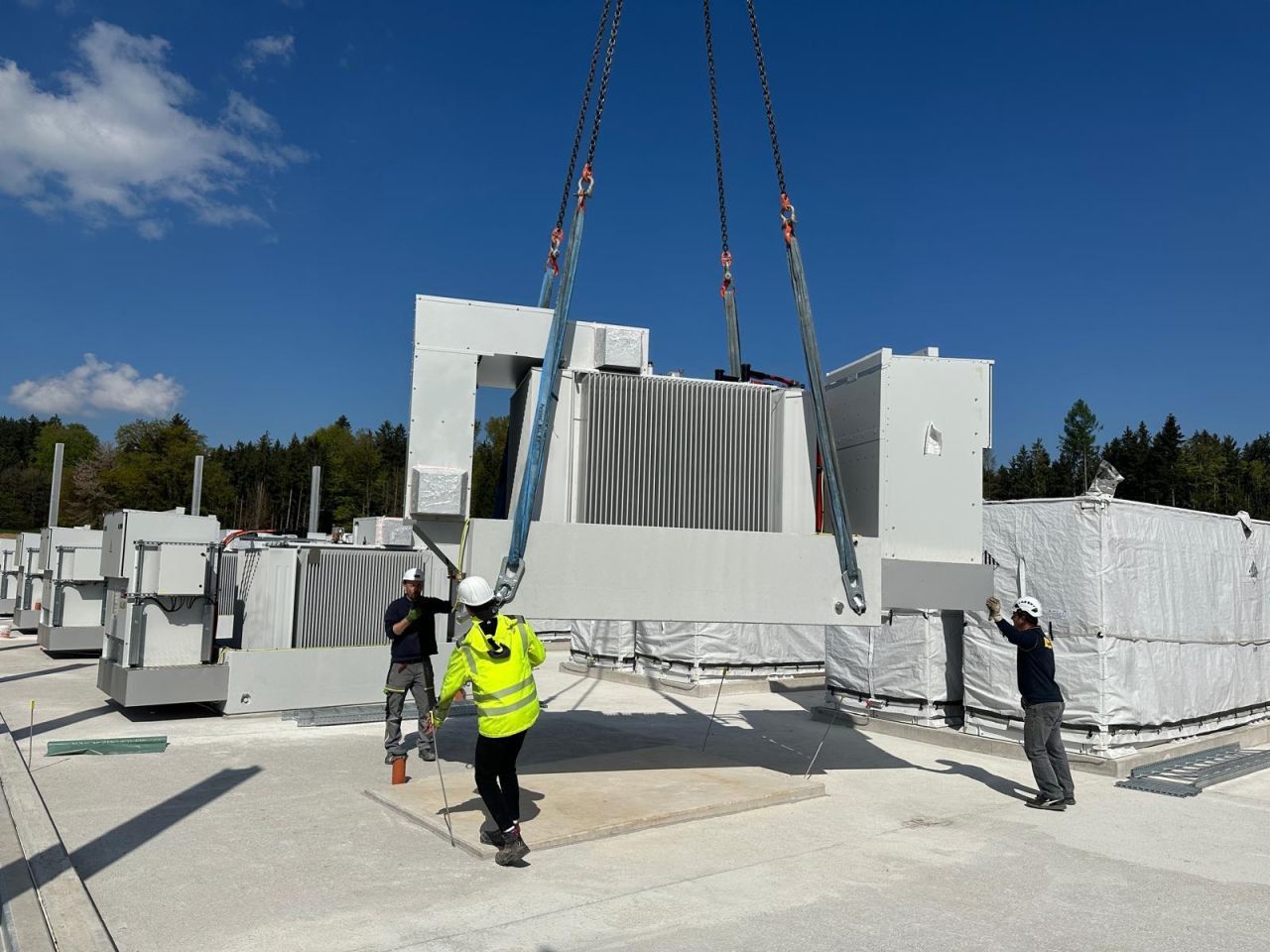
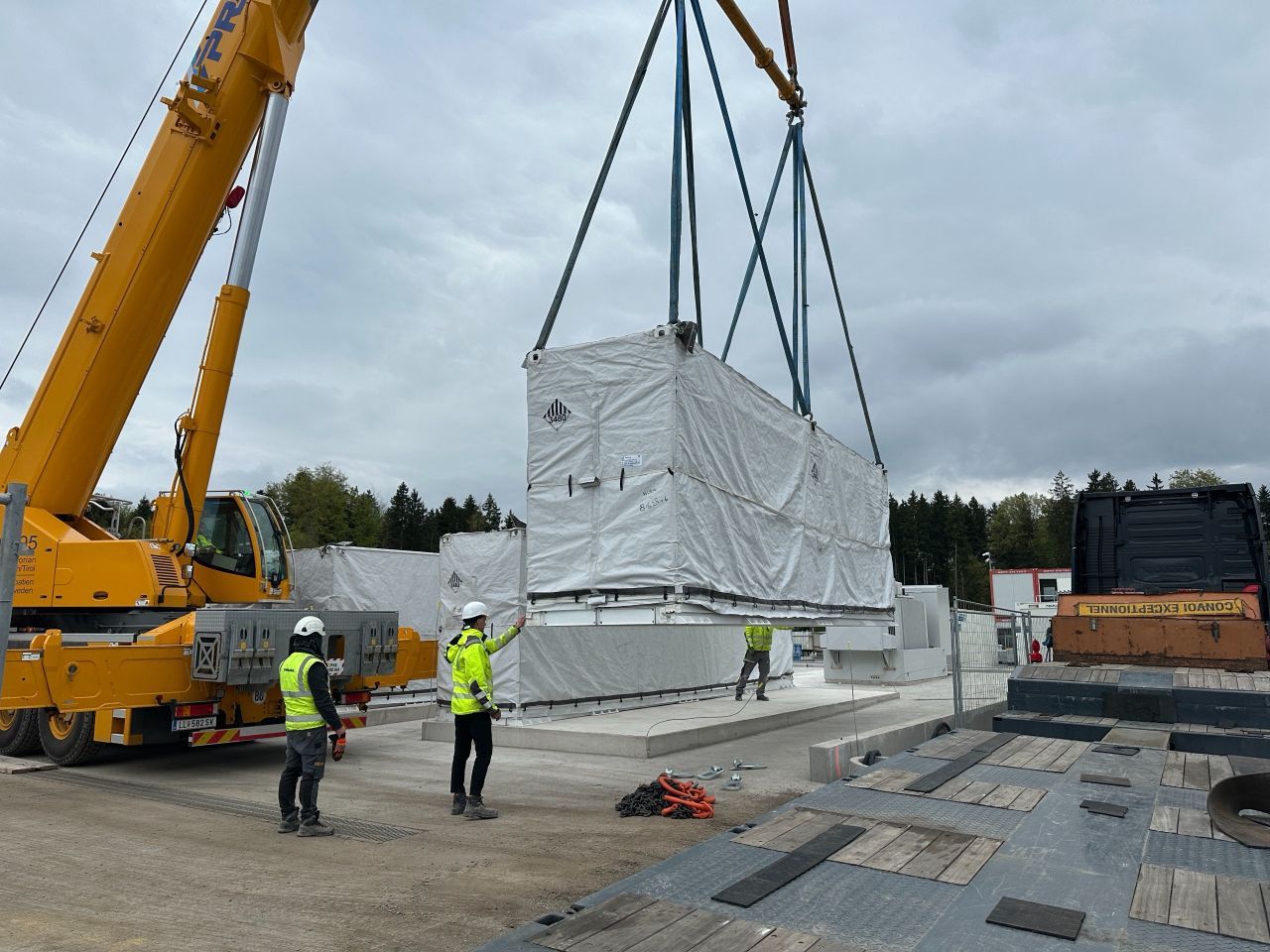
- Transportable by standard truck or open-top container
Additionally, each configuration incorporates the specific components required for its PCS architecture, as detailed below.
BPS-S: Battery Power Station String — for multi-PCS systems integrated into the battery container
Description and concept
The BPS-S is designed to connect to battery containers incorporating multi-PCS technology, i.e. several PCS units with an individual power range of approximately 200–300 kW, integrated into the container itself. In this architecture, the battery container delivers energy directly in AC at the container output.
The BPS-S receives AC power from the battery containers, steps it up to medium voltage through the transformer, and feeds it into the grid. Compared with architectures based on a centralized PCS, the Multi-PCS configuration offers a higher degree of modularity, redundancy, and flexibility. Independent management of each battery block makes it possible to maximize plant availability, optimize efficiency under any operating conditions, and facilitate future expansions or maintenance interventions without compromising the overall production of the system.
BPS-S technical specifications
| Parameter | Value / Range |
|---|---|
| Maximum AC power | Up to 9,600 kVA (customizable) at 40 °C |
| Primary voltage (MV) | Up to 40.5 kV │ Um/UAC/ULI: 40.5–95–185 kV |
| Secondary voltage (LV) | Up to 1,000 V (Dy11 vector group). Option with double secondary winding. |
| Transformer type | Hermetically sealed corrugated tank / KNAN / Aluminium MV and LV windings |
| MV switchgear (RMU) | SF6-free up to 24 kV │ SF6 up to 40.5 kV │ 630 A / 20/25 kA/1s │ 2L1P configuration |
| LV circuit breaker (ACB) | Up to 2 × 4,000 A / LSI / 1,000 Vac / 85 kA / 3P |
| Auxiliary transformer | Up to 250 kVA |
| Dimensions (L × W × H) | 6,385 × 2,050 × 2,750 mm |
| Maximum weight | < 24 t |
| Operating temperature | −15 °C ~ 60 °C │ Humidity 0–95% |
| Maximum operating altitude | 2,000 m (higher altitude available as an option) |
| Protection | IP54 / C4H transformer and LV panel, C5M MV switchgear |
| Minimum applicable standards | IEC 61936, IEC 62271-202, IEC 60076, IEC 61439, IEC 62271-200, and local regulations in each country |
Compatibility with BESS systems
The BPS-S is compatible with the main multi-PCS architecture BESS systems on the market:
- Fluence — Smartstack and Gridstack
- Sungrow — Power Titan
- Huawei — Luna 2000
- Mars — Socrates
- Other BESS systems with multi-PCS systems integrated into the battery container
When to choose the BPS-S
- Projects with multi-PCS architecture BESS: when the selected battery manufacturer integrates the PCS units within the battery container itself.
- High modularity required: when the project requires phased scalability or multiple battery containers connected in parallel.
- Tight timelines: the BPS-S is the most standard solution in the BPS family, requiring less specific engineering time.
- Power ratings up to 9.6 MVA per unit: it covers most utility-scale projects with high energy-density containers.
BPS-C: Battery Power Station Central — for systems with centralized PCS external to the battery container
Description and concept
The BPS-C is designed for BESS installations that use an external centralized Power Conversion System (PCS). In this architecture, the PCS is not integrated inside the battery container, but is an independent piece of equipment with a higher unit power rating that is physically integrated on the skid of the BPS-C.
The battery container delivers direct current (DC) energy to the centralized PCS, which performs the DC/AC conversion. The BPS-C integrates that PCS, together with the MV switchgear cell and the transformer, into a single prefabricated unit.
This solution is also applicable to hybrid systems with coupling on the direct current side of the PCS (DC coupling).
BPS-C technical specifications
| Parameter | Value / Range |
|---|---|
| Maximum AC power | Up to 8,800 kVA (customizable) at 40 °C |
| Primary voltage (MV) | Up to 40.5 kV │ Um/UAC/ULI: 40.5–95–185 kV |
| Secondary voltage (LV) | Up to 1,000 V (Dy11 vector group). Option with double secondary winding. |
| Transformer type | Hermetically sealed corrugated tank / KNAN / Aluminium MV and LV windings |
| MV switchgear (RMU) | SF6-free up to 24 kV │ SF6 up to 40.5 kV │ 630 A / 20/25 kA/1s │ 2L1P configuration |
| Integrated PCS | Central PCS integrated into the skid |
| Auxiliary transformer | Up to 250 kVA |
| Auxiliary services panel | Customizable according to consumption |
| Dimensions (L × W × H) | Up to 10,150 × 2,050 × 2,750 mm |
| Maximum weight | < 24 t |
| Operating temperature | −15 °C ~ 60 °C │ Humidity 0–95% |
| Maximum operating altitude | 2,000 m (higher altitude available as an option) |
| Protection | IP54 / C4H transformer, C5M MV switchgear, C4H fencing |
| Minimum applicable standards | IEC 61936, IEC 62271-202, IEC 60076, IEC 61439, IEC 62271-200, and local regulations in each country |
Compatibility with BESS systems
The BPS-C is compatible with BESS systems that use external centralized PCS:
- Power Electronics — Freemaq PCSK
- SMA — Sunny Central Storage
- Ingeteam — Sun Storage M series
- Zigor — ZGR-PCS4500
- Other centralized PCS with high unit power
When to choose the BPS-C
- Centralized PCS architecture: when the project specifies a high-power centralized PCS instead of a multi-PCS system.
- Projects with higher unit power: the centralized PCS improves CAPEX in high-power projects.
- Centralized control and monitoring: the BPS-C architecture simplifies the management of communications between PCS-BMS-PPC, and therefore the dynamic energy management of the installation.
- CAPEX optimization in large installations: the higher the unit power of the PCS, the fewer BPS units are required for the same MW of BESS capacity.
- Hybridization with DC coupling: the centralized PCS of some manufacturers allows the design of hybrid systems with coupling on the direct current (DC) side (DC coupling), which makes it possible to convert the energy generated by a photovoltaic plant together with the energy generated or consumed by a BESS system through the same PCS.
BPS-D: Battery Power Station Decoupled — for systems with centralized PCS integrated into the battery container
Description and concept
The BPS-D is designed to connect directly to battery containers that already incorporate their own integrated centralized PCS. In this architecture, the battery container is an autonomous unit that includes both the battery cells and the PCS, and delivers energy in AC at its output.
Unlike the BPS-S, the BPS-D container does not use a multi-PCS configuration but rather its own centralized PCS. The BPS-D acts as the voltage step-up and grid connection interface, without the need to integrate any additional power conversion component. Its design is more compact than the BPS-S because it does not require the complex low-voltage panel with multiple outputs to protect each PCS.
BPS-D technical specifications
| Parameter | Value / Range |
|---|---|
| Maximum AC power | Up to 7,200 kVA at 40 °C (customizable) |
| Primary voltage (MV) | Up to 40.5 kV │ Um/UAC/ULI: 40.5–95–185 kV |
| Secondary voltage (LV) | Up to 1,000 V (Dy11 vector group). Option with double secondary winding. |
| Transformer type | Hermetically sealed corrugated tank / KNAN / Aluminium MV and LV windings |
| MV switchgear (RMU) | SF6-free up to 24 kV │ SF6 up to 40.5 kV │ 630 A / 20/25 kA/1s │ 2L1P configuration |
| Auxiliary transformer | Up to 250 kVA |
| Auxiliary services panel | Customizable according to consumption |
| Dimensions (L × W × H) | 4,457 × 2,050 × 2,750 mm |
| Maximum weight | < 22 t |
| Operating temperature | −15 °C ~ 60 °C │ Humidity 0–95% |
| Maximum operating altitude | 2,000 m (higher altitude available as an option) |
| Protection | IP54 / C4H transformer, C5M MV switchgear, C4H fencing |
| Minimum applicable standards | IEC 61936, IEC 62271-202, IEC 60076, IEC 61439, IEC 62271-200, local regulations in each country |
Compatibility with BESS systems
The BPS-D is the specific solution for BESS systems with their own integrated PCS:
- Tesla — Megapack
- Other BESS systems with centralized PCS integrated into the container
When to choose the BPS-D
- Projects with Tesla Megapack or equivalent systems: when the BESS contract specifies a system with its own integrated non-separable PCS.
- Maximum simplicity of electrical integration: the BPS-D is the most compact configuration in the family, with a lower number of active electrical components.
- Reduction of commissioning times: as it does not require integration of an external PCS, the electrical commissioning process is faster.
- Projects with a closed BESS manufacturer specification: when the battery system manufacturer contractually defines the required electrical interface.
Technical comparison BPS-S vs BPS-C vs BPS-D
| Parameter | BPS-S (String) | BPS-C (Central) | BPS-D (Decoupled) |
|---|---|---|---|
| PCS architecture | Multi-PCS integrated into the battery container | External centralized PCS integrated into the BPS | Centralized PCS integrated into the battery container |
| Maximum power | 9.6 MVA | 8.8 MVA | 7.2 MVA |
| Secondary voltage | Up to 1,000 Vac | Up to 1,000 Vac | Up to 1,000 Vac |
| Complex LV panel | Yes (ACB + multiple MCCB outputs) | No (auxiliary services panel only) | No (auxiliary services panel only) |
| Platform length | 6,385 mm | 10,150 mm | 4,457 mm |
| Maximum weight | < 24 t | < 24 t | < 22 t |
| Fluence compatibility | Yes (Smartstack, Gridstack) | No | No |
| Sungrow compatibility | Yes (Power Titan) | No | No |
| Huawei compatibility | Yes (Luna 2000) | No | No |
| Mars compatibility | Yes (Socrates) | No | No |
| Power Electronics compatibility | No | Yes (Freemaq PCSK) | No |
| SMA compatibility | No | Yes (Sunny Central Storage) | No |
| Ingeteam compatibility | No | Yes (Sun Storage M series) | No |
| Zigor compatibility | No | Yes (ZGR-PCS4500) | No |
| Tesla compatibility | No | No | Yes (Megapack) |
| Modularity / scalability | High | Medium | High (manufacturer-dependent) |
| Commissioning complexity | Medium | Medium-high | Low |
| Compactness | Medium | Lower (greater length) | High (more compact) |
Decision tree: how to choose the right BPS for your BESS project
The PCS architecture of the battery system is the main factor in the choice of BPS configuration. There is no universally better BPS: the right one is the one that is compatible with the battery system specified in the project.
Follow these steps to determine which BPS configuration is suitable for your project:
- Does the battery manufacturer integrate the PCS units inside the container?
- Yes, they are distributed PCS units: → BPS-S. Verify compatibility with the specific model (Fluence Smartstack and Gridstack, Sungrow Power Titan, Huawei Luna 2000, etc.)
- Yes, it is a centralized PCS specific to the manufacturer (Tesla Megapack): → BPS-D.
- No, the PCS is an independent external unit: → Go to step 2.
- Is the external PCS from Power Electronics, SMA, Ingeteam, or Zigor?
- Yes: → BPS-C. The platform integrates the centralized PCS together with the MV switchgear and transformer.
- No (other PCS manufacturer): → Contact the MEINS technical team for compatibility analysis and a customized configuration.
- Does the project require future expansion or connection of multiple containers?
- Yes, with multi-PCS architecture: → BPS-S offers the greatest scaling flexibility.
- Yes, with centralized PCS: → BPS-C allows aggregated power to be increased by adding units.
- Yes, with Tesla Megapack: → BPS-D, one per container or group of containers depending on the configuration.
Differentiating features shared by all BPS configurations
Regardless of the configuration selected, all MEINS BPS units share a set of differentiating features that distinguish them from standard solutions on the market:
- Fully customized design: each BPS is specifically designed for the project, the connection point, and the electrical architecture. There are no fixed catalogue solutions.
- European manufacturing with declaration of origin: 100% manufactured at MEINS facilities in Spain, with full component traceability.
- Integrated auxiliary services transformer: up to 250 kVA for supplying auxiliary services to the BESS system.
- Energy metering options: possibility of integrating energy metering in LV and MV to comply with grid operator requirements.
- Voltage scalability up to 66 kV: possibility of scaling the grid connection voltage, reducing in many cases the need for a conventional HV/MV substation.
- Transportable by standard truck or open-top container: dimensions and weights optimized for international logistics without special transport restrictions.
- Compatible with hybrid PV + BESS plants: all configurations can be integrated into projects combining solar generation and energy storage, both for DC and AC coupling (LV or MV).
- Regulatory compliance: IEC 61936, IEC 62271-202, IEC 60076, IEC 61439, IEC 62271-200, local regulations in each country.
Frequently asked questions about Battery Power Stations (BPS)
What is the difference between a BPS and a conventional transformer station?
A conventional transformer station is designed for general electrical distribution networks. A BPS is specifically designed to integrate BESS systems: it incorporates the electrical architecture required to connect directly to the battery container (including specific protections, communications with the PCS, and management of DC/AC or AC/AC conversion depending on the configuration), with a geometry and Plug & Play philosophy optimized for utility-scale storage projects.
Can a BPS-S be connected to a Tesla Megapack?
Not directly. The Tesla Megapack uses its own integrated centralized PCS, which requires the BPS-D. The BPS-S is designed for containers with a multi-PCS architecture. Using a BPS-S with a Megapack would require a specific engineering adaptation that, in practice, is neither standard nor recommended.
How many BPS units are needed for a 100 MW 2h BESS project?
It depends on the power of each battery container and the project configuration. As a reference, with 9.6 MVA BPS-S units, a project with 100 MW of nominal power and 2h storage capacity would require between 10 and 11 BPS-S units. The MEINS engineering team sizes the optimal configuration for each project based on the plant topology, grid operator requirements, and battery manufacturer specifications.
Can the grid connection voltage be scaled beyond 40.5 kV with a BPS?
Yes. MEINS BPS units can be configured for grid connections of up to 66 kV, eliminating in many projects the need for a conventional HV/MV substation between the BPS and the connection point. For voltages above 66 kV, the appropriate solution is the CSET (Compact Substation), which can reach up to 138 kV.
Do MEINS BPS units have an SF6-free option?
Yes. All BPS configurations offer an SF6-free medium-voltage switchgear option, with a rated voltage of up to 24 kV. This option responds to the growing environmental requirements of projects in markets where the elimination of SF6 is a contractual or regulatory specification.
What is the typical delivery time for a BPS?
The manufacturing and delivery time of a BPS depends on the configuration, power, and level of customization of the project. For standard projects, the usual lead times are between 25 and 30 weeks from order confirmation and completion of the technical definition. For projects with high engineering complexity or long-lead components, the lead time may be extended. MEINS coordinates the delivery schedule with the overall BESS project schedule to ensure alignment with the energization milestones.
Conclusion
The choice between BPS-S, BPS-C and BPS-D is not a decision based on technical preference: it is a decision based on compatibility with the architecture of the battery system selected for the project. The correct configuration is the one that aligns with the appropriate PCS for the battery container model specified.
With 28 years of experience in the design and manufacturing of prefabricated electrical infrastructure and more than 11 GW installed in more than 35 countries, MEINS has developed the BPS family as a mature, tested and certified technical solution for the electrical integration of utility-scale BESS systems in any geography and under any applicable regulations.
If you are in the basic engineering or supplier selection phase for a BESS project, the MEINS technical team can help you define the optimal BPS configuration for your project, from electrical sizing to delivery logistics in the field.