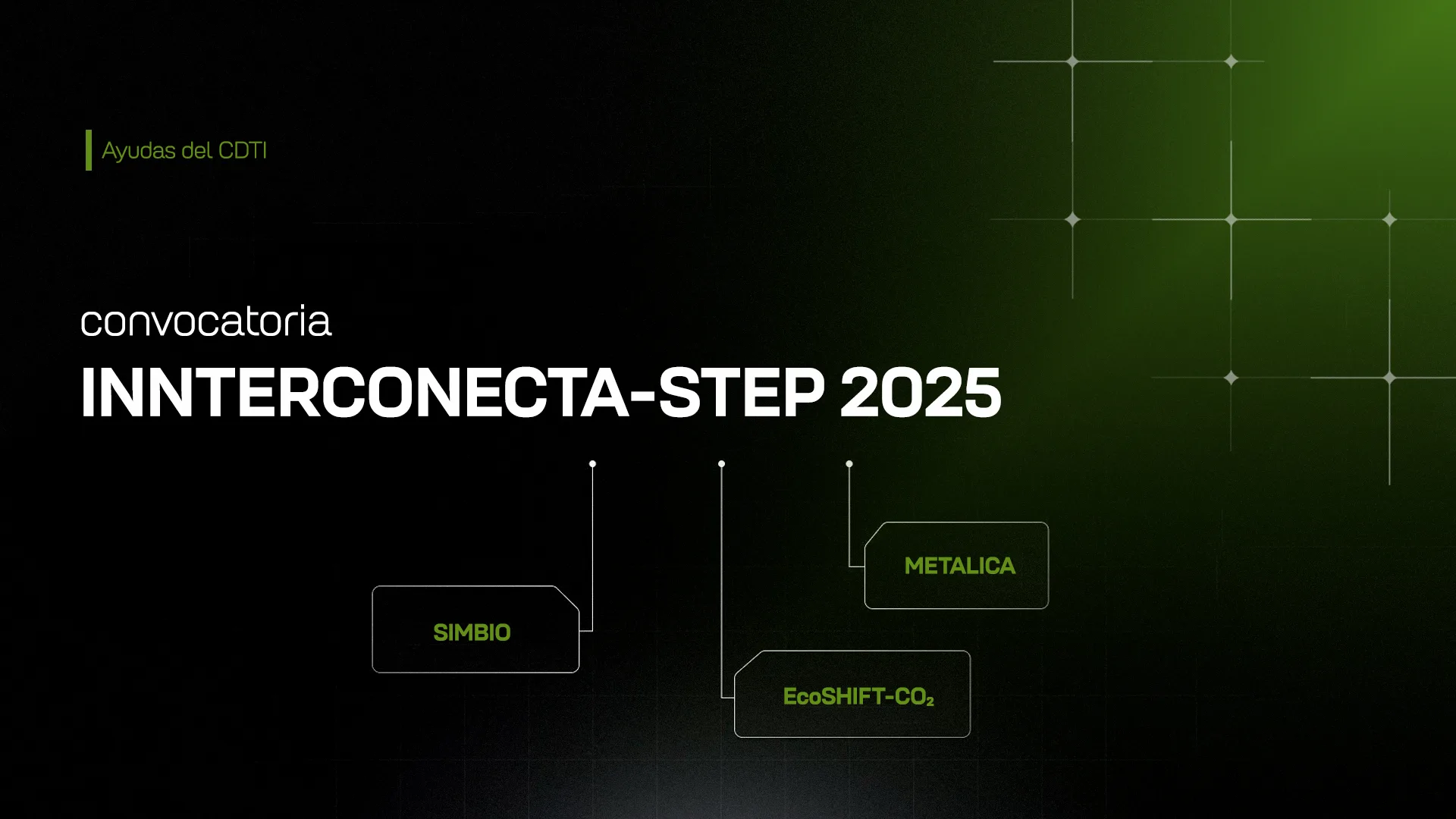
Meins is taking part in three research and innovation projects that have received funding from CDTI under the INNTERCONECTA-STEP 2025 call. Together, the funding we receive exceeds €1.7 million.
More and more companies need to cut their emissions, make better use of resources and rely on technology to become more efficient. To meet that challenge, CDTI (Spain’s Centre for the Development of Industrial Technology), with ERDF 2021-2027 funds, supports R&D projects in which companies and research centres work together. We are part of three of them, each tackling the industrial transition from a different angle: energy, waste and materials.
SIMBIO: Giving Waste a Second Life
SIMBIO is built on the idea that one company’s waste can be another’s raw material. The project uses biomass residues, such as forestry waste, and CO₂ of biogenic origin to produce sustainable fuels. To do so, it develops an integrated technological solution that uses artificial intelligence and digital twins to improve energy efficiency and reduce environmental impact.
The final goal is to define a replicable pilot system that can be applied in the energy, forestry and agri-food sectors, in biogas plants and in industries with high CO₂ emissions. The project is carried out in Castilla y León, Andalusia, the Valencian Community and Murcia.
METALICA: Recycled Aluminium for Better Construction
METALICA applies the circular economy to the aluminium used in industrialised construction. The project develops new recycled aluminium alloys, makes use of the waste generated in metal production, designs thermal storage systems for buildings and creates a digital tool for designing more sustainable construction.
The expected result is eco-designed aluminium components and a construction system with a lower environmental footprint. The project is carried out in Castilla y León, Galicia and the Basque Country.
EcoSHIFT-CO₂: Smart Energy for Industry
EcoSHIFT-CO₂ creates an energy ecosystem for industrial facilities that combines renewable energy, electrical and thermal energy storage and digital tools. Thanks to artificial intelligence and digital twins, the platform will be able to predict and optimise how much energy is generated, stored and consumed. This makes better use of renewables and reduces CO₂ emissions.
The solution will be validated in a pilot case in the meat industry and is designed for any industry with electrical and thermal demand. The project is carried out in Castilla y León and Andalusia.
The Projects at a Glance
| SIMBIO | METALICA | EcoSHIFT-CO₂ | |
| CDTI file number | ITC-20251189 | ITC-20251049 | ITC-20251131 |
| Duration | Jan. 2026 – Sep. 2028 | Jul. 2025 – Jun. 2028 | Nov. 2025 – Oct. 2028 |
| Where it is carried out | Castilla y León, Andalucía, C. Valenciana y Murcia | Castilla y León, Galicia y País Vasco | Castilla y León y Andalucía |
| Project budget | €3,398,790 | €3,165,013 | €2,007,070 |
| Funding to MEINS | €448,707.00 | €505,060.17 | €762,550.84 |
Total funding to MEINS across the three projects: €1,716,318.01
Why These Projects Matter to Us
Although they work with different technologies, the three projects share three ideas. They aim to decarbonise industry, close the loops of materials and resources, and rely on digitalisation to make better decisions. We also work with consortia of companies and research centres from several regions of Spain, which helps ensure the solutions are replicable and reach real industry.
At MEINS, we believe innovation is a tool for making companies more competitive and sustainable. We will continue to share the progress of each project.

These projects have received funding from CDTI with ERDF 2021-2027 funds through the INNTERCONECTA-STEP Regional Consortia support programme. Funded by CDTI. Projects supported by the Spanish Ministry of Science, Innovation and Universities. Co-funded by the European Union. #EuropaSeSiente