Technical Summary
THAWI (Thermal Heat and Water Innovation) is a system developed by MEINS that converts photovoltaic DC electricity into useful heat through isolated DC resistive heating (Joule effect). It produces hot water up to 95 °C with approximately 99% efficiency — no inverters, no grid connection, no combustion.
The system is designed for industrial applications where process heat represents a significant operational cost and a major source of CO₂ emissions.
Key data point: According to NREL, approximately two thirds of industrial heat demand occurs below 300 °C. THAWI operates in the lower end of that spectrum (up to 95 °C), covering applications where gas or oil boilers are less efficient and more expensive to operate.
How THAWI works: technical principle
The system receives DC electricity directly from the photovoltaic array. Unlike conventional self-consumption systems that convert DC to AC through inverters before feeding resistive loads, THAWI eliminates that intermediate conversion.
The process is:
- Photovoltaic modules generate DC electricity.
- THAWI receives that DC current directly, without passing through an inverter or injecting into the grid.
- Industrial resistive heating elements in an isolated circuit convert the electrical energy into heat via the Joule effect.
- Water circulates through the system and is heated instantaneously.
The electrical-to-thermal conversion efficiency is approximately 99%, since the Joule effect is essentially total: all electrical energy is dissipated as heat. There are no DC-to-AC conversion losses, no inverter losses, and none of the thermal transport losses through heat transfer fluid piping that occur in conventional solar thermal systems.
THAWI technical specifications
| Parameter | Value |
|---|---|
| Available power ratings | 40 kW · 60 kW · 80 kW · 100 kW |
| Maximum output temperature | 95 °C |
| Maximum flow rate | 4.4 m³/h |
| Current type | Isolated DC (no inverter) |
| Electrical-to-thermal conversion efficiency | ~99% (Joule effect) |
| Thermal response time | 500 milliseconds |
| Grid connection | Not required (off-grid capable) |
| Combustion | None |
| Working fluid | Water |
Note for engineers: Power configuration must be sized according to the dedicated photovoltaic array capacity and the installation’s thermal demand profile. MEINS performs the engineering study for each project, including solar production simulation, demand analysis and hydraulic system design.
Plant integration modes
THAWI can be integrated in three configurations:
Dedicated photovoltaic plant: The solar array is sized exclusively to feed THAWI. All photovoltaic production is converted into heat. This configuration maximises thermal output and simplifies the system design.
Shared installation with electrical self-consumption: Part of the photovoltaic production feeds THAWI for thermal generation, with the remainder going to conventional AC self-consumption (with inverter). Requires an energy management system to distribute production between both uses.
Integration into an existing hybrid system: THAWI acts as a preheating system for the return circuit of a conventional boiler. Water returns to the boiler at a higher temperature, reducing the thermal rise required and decreasing fuel consumption (gas, oil or propane). This configuration is particularly valuable for retrofits where replacing the existing boiler is not desired.
THAWI vs. conventional thermal generation systems: technical comparison
THAWI vs. natural gas boiler
A gas boiler converts fossil fuel into heat through combustion, with typical efficiencies of 85–95%. THAWI burns nothing: it converts solar electricity into heat at ~99% efficiency. The fundamental difference is not only in efficiency but in cost structure: the boiler depends on volatile gas prices, while THAWI has a predictable energy cost based on the amortisation of the photovoltaic installation.
THAWI vs. air source heat pump
Heat pumps offer COPs of 3–4 at low temperatures (35–45 °C for space heating), but that COP drops significantly when water at 60–95 °C is required for industrial processes. At 95 °C, THAWI delivers stable performance independent of outdoor temperature, while a heat pump requires grid consumption and its efficiency is limited by ambient conditions.
THAWI vs. solar thermal (vacuum tube collectors)
Conventional solar thermal uses collectors to heat a heat transfer fluid that then transfers its energy to process water. It works well, but involves a complex hydraulic circuit (glycol, circulation pump, heat exchanger, expansion vessel) with thermal losses in transport. THAWI eliminates all that complexity: electrical cables instead of pipework. Maintenance is drastically reduced and there is no risk of heat transfer fluid overtemperature.
THAWI vs. residential photovoltaic heating (FOT-T type regulators)
FOT-T type regulators for residential photovoltaic heating apply the same physical principle (Joule effect with DC photovoltaic power), but are designed for domestic ACS water heaters with power ratings of 2–5 kW. THAWI scales that concept to the industrial level (40–100 kW), with high flow rate management (up to 4.4 m³/h), ultrafast response (500 ms) and SCADA monitoring. These are different product categories.
Industrial applications of THAWI
Food and beverage industry
Pasteurisation, blanching, CIP (Clean-in-Place) cleaning and ingredient preparation processes require hot water at temperatures between 60 and 95 °C on a continuous basis. THAWI covers that range with precision and thermal stability.
Industrial laundries
Hospital, hotel and residential laundries consume large volumes of hot water. THAWI can reduce or eliminate dependence on oil-fired boilers in facilities with available space for a photovoltaic array.
Hotel and healthcare sector
Centralised domestic hot water, swimming pool heating and low-temperature space heating are applications with constant and predictable thermal demand — ideal conditions to maximise the performance of a solar thermal system like THAWI.
Boiler water preheating
In installations where the existing boiler cannot or should not be replaced, THAWI preheats the return circuit. If return water enters at 35 °C instead of 15 °C, the boiler needs less energy to reach the set temperature. This directly reduces fuel consumption.
Industrial thermal processes
Any process requiring stable heat between 40 and 95 °C: material curing, surface treatment, storage tank heating, and similar applications.
THAWI and Energy Savings Certificates (CAE) in Spain
One of the most relevant economic aspects of THAWI in 2026 is its potential fit within the Spanish Energy Savings Certificates (Certificados de Ahorro Energético, CAE) system.
The CAE system in Spain, regulated by Royal Decree 36/2023 and Order TED/133/2026, allows companies implementing energy efficiency measures to obtain certificates equivalent to the savings achieved (1 CAE = 1 kWh saved), which can be sold to obligated parties (energy retailers).
How it applies to THAWI: If an industrial installation partially replaces the thermal consumption of a gas boiler with direct THAWI generation fed by photovoltaics, the final energy savings (kWh of gas not consumed) can be certifiable as CAEs.
Indicative calculation example:
A THAWI installation of 80 kW in an area with 1,600 equivalent sun hours per year would generate approximately 128,000 kWh of thermal energy annually. If those kWh replace natural gas consumption with a 90% boiler efficiency, the final energy saving would be approximately 142,000 kWh (142 MWh). At an estimated CAE market price of €85–155/MWh, this would represent an additional income of between €12,000 and €22,000 per year from certificate monetisation.
Important: The viability of CAE generation for a specific THAWI installation depends on verification by an ENAC-accredited verifier, compliance with Order TED requirements, and quantification of actual savings against the reference scenario. MEINS can advise on the eligibility of each project.
THAWI APP: remote monitoring and control
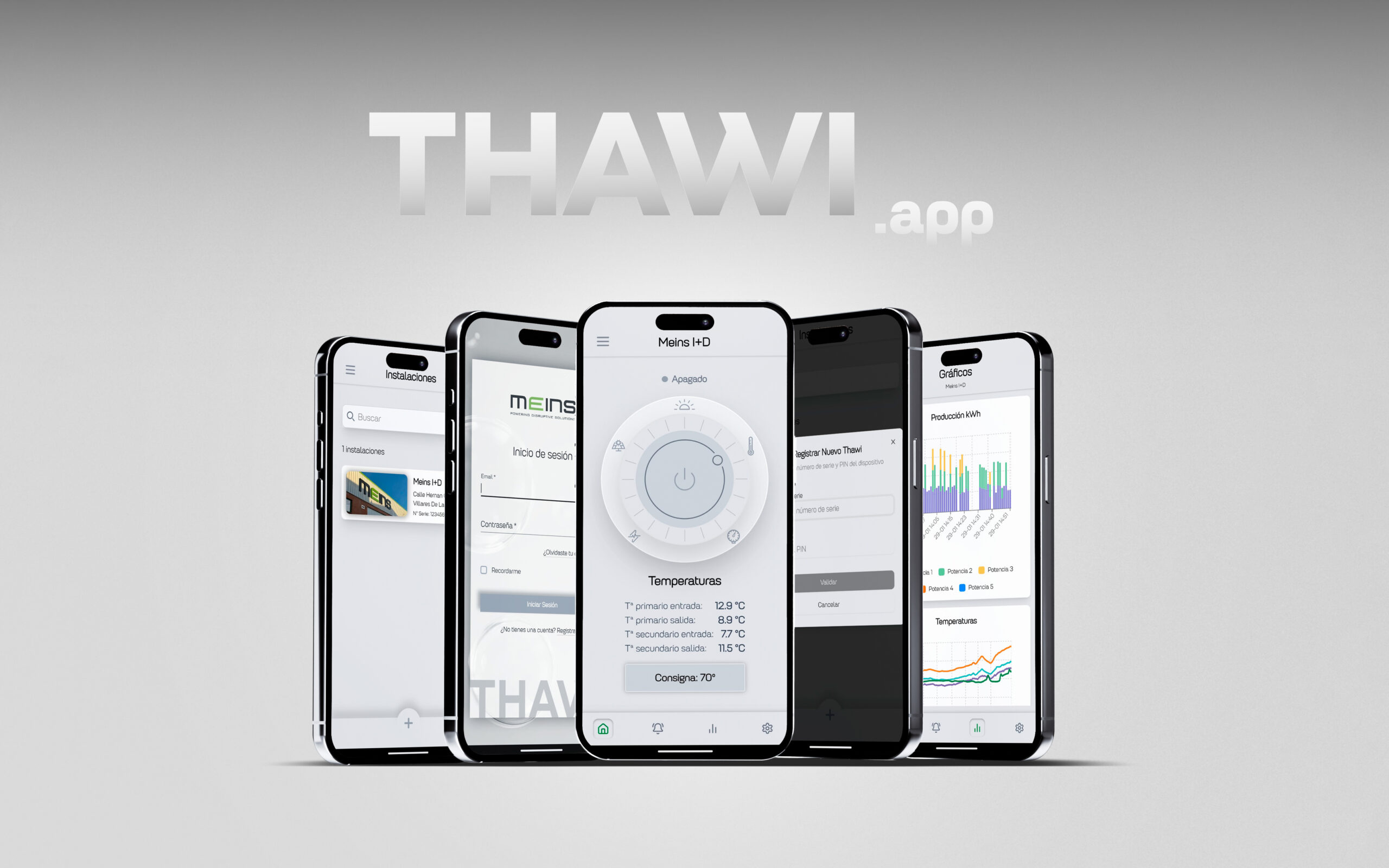
MEINS complements the THAWI system with a mobile application (available on the App Store and Google Play) connected to the installation’s SCADA. Functionalities include:
Real-time monitoring: Inlet, outlet and flow temperatures. Electrical parameters of the photovoltaic array. System operating status.
Operational control: Remote adjustment of temperature set points. Alarm detection and management. Access to operational history and performance trend analysis.
Energy optimisation: The app enables identification of consumption patterns, system configuration optimisation and maximisation of photovoltaic production utilisation.
Impact on industrial decarbonisation
By replacing fossil fuels with solar photovoltaic energy for thermal generation, THAWI directly reduces the CO₂ emissions of the installation. Each kWh of thermal energy generated with THAWI instead of a natural gas boiler avoids approximately 0.2 kg of CO₂ (standard emission factor for natural gas thermal generation).
For an 80 kW installation with 128,000 kWh/year of solar thermal output, this means avoiding approximately 25.6 tonnes of CO₂ per year.
Furthermore, the impact is quantifiable and reportable under ISO 14064 standards (quantification of greenhouse gas emissions) — a certification that MEINS already holds.
THAWI within MEINS innovation strategy
MEINS is a Spanish engineering company with over 28 years of experience, more than 11 GW of installed power across 35+ countries, and ISO 9001, 14001 and ISO 14064 certifications. Its core activity is prefabricated electrical infrastructure for renewable energy, BESS, data centres and industrial applications.
THAWI represents the extension of that engineering capability into industrial thermal self-consumption — a segment where the energy transition still has enormous ground to cover. Most industrial decarbonisation strategies have focused on electrifying electrical consumption, but process heat — which represents a critical part of energy consumption in sectors such as food, pharmaceuticals, chemicals and textiles — remains predominantly dependent on fossil fuels.
Frequently asked questions about THAWI and industrial thermal self-consumption
Can THAWI completely replace an industrial boiler?
It depends on the demand profile. In installations with predominantly daytime thermal demand and process temperatures below 95 °C, THAWI can cover a high percentage of demand during solar production hours. For nighttime demand or peaks exceeding the photovoltaic array capacity, it is recommended to retain the boiler as backup or install thermal storage. MEINS sizes each project to maximise the solar thermal fraction.
What photovoltaic array area does a 100 kW THAWI installation require?
For 100 kW with current photovoltaic modules (~550 Wp per panel), approximately 182 panels are required, equivalent to around 400–450 m² of photovoltaic array surface (excluding maintenance walkways). The actual surface will depend on orientation, tilt and shading at the site.
Does THAWI require batteries or electrical storage?
No. THAWI does not store electricity; it directly converts photovoltaic production into heat. If heat availability beyond solar production hours is required, storage is thermal (hot water tanks), not electrical. Thermal storage tanks are significantly more economical than lithium batteries.
Does THAWI work on cloudy days?
Yes, but at reduced power proportional to available irradiance. The 500-millisecond response time allows the system to adapt instantaneously to radiation variations. On partly cloudy days, THAWI continues producing heat, albeit at reduced flow or temperature.
Is THAWI compatible with Energy Savings Certificates (CAE)?
THAWI is a technology capable of generating CAEs when it replaces fossil thermal consumption with solar energy. Savings must be verified by an ENAC-accredited verifier. MEINS advises on eligibility and the certification process for each project.
What maintenance does THAWI require?
With no moving parts, no heat transfer fluid circuit and no burners, maintenance is minimal. It is limited to periodic reviews of the hydraulic system (filters, valves), verification of electrical connections and water quality control. Remote monitoring through THAWI APP allows early identification of issues.
How does THAWI differ from residential photovoltaic heating regulators?
Residential photovoltaic heating (FOT-T type regulators) operates at 2–5 kW to heat a domestic water heater. THAWI scales that principle to the industrial level: 40–100 kW power ratings, flow rates up to 4.4 m³/h, 500 ms response time, SCADA integration and remote monitoring. They are different product categories.
In which countries is THAWI available?
MEINS operates in more than 35 countries. THAWI can be supplied and installed in any market with sufficient solar resource and industrial thermal demand. Contact MEINS for a feasibility study adapted to your location and consumption profile.
Technical article published by MEINS — Spanish engineering firm specialised in prefabricated electrical infrastructure for renewable energy, BESS, data centres and industrial applications. Over 28 years of experience, 11+ GW installed, presence in 35+ countries. ISO 9001, ISO 14001 and ISO 14064 certified.